> For the complete documentation index, see [llms.txt](https://docs.deltaquad.com/sth/llms.txt). Markdown versions of documentation pages are available by appending `.md` to page URLs; this page is available as [Markdown](https://docs.deltaquad.com/sth/flight/deltaquad-controller.md).
# DeltaQuad Controller
The DeltaQuad Evo Enterprise Edition comes with the DeltaQuad Controller. It provides the communication link between your UAV and the ground systems.
The following section gives a basic overview of the DeltaQuad Controller and its functionality.
The DeltaQuad Controller has three working frequency bands of 800MHz(806-826Mhz), 1.4GHz(1427-1467Mhz), and 2.4GHz(2401.5-2481.5MHZ). It comes with interchangeable antennas to match the frequency band of choice.
{% hint style="info" %}
The 800MHz frequency band is not capable of transmitting a video link.
{% endhint %}
## Getting started
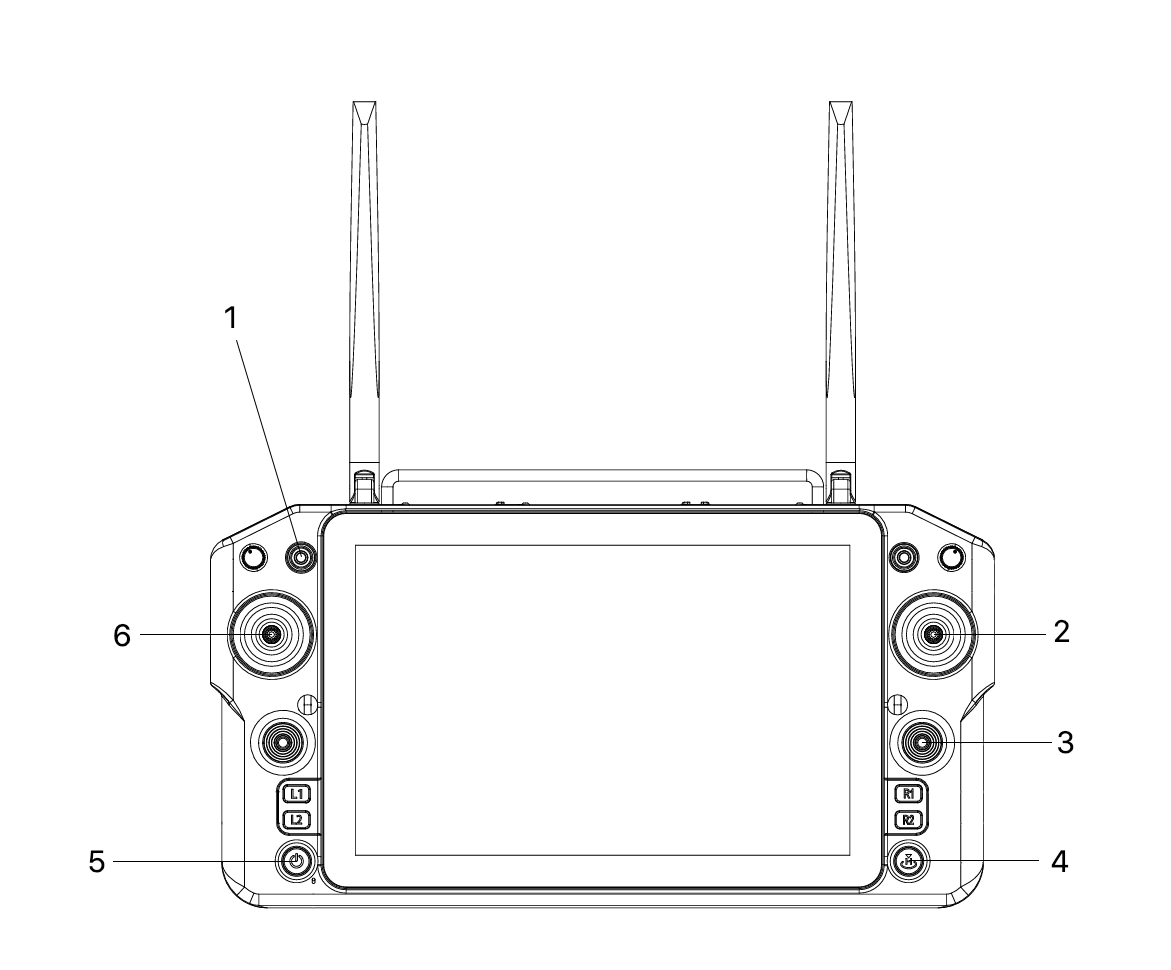
To connect your UAV to the DeltaQuad Controller simply switch on the UAV and press and hold the POWER button (5) on the controller for 5 seconds. Once the controller is booted up, the main menu will display.
Before launching your flight control system it is recommended to connect the controller to a mobile hotspot or Wi-Fi network. The controller uses internet connectivity to load satellite maps and for LTE connectivity to the UAV. The DeltaQuad controller must be connected to a 5Ghz mobile hotspot or WiFi network. As one of the primary communication links for the controller is based on 2.4 GHz, these networks will not be displayed. When using a mobile phone hotspot, please configure the hotspot for 5 GHz. Alternatively, you can insert a SIM Card for internet connectivity.
## Overview of the buttons
| Number | Type | Function |
| ------ | ----------------------------------------------------------- | ---------------------------------------------------------------------------------------------------------------------------------------------------------------------------------------------------------------------------------------------------------------------------------------------------------------------------------------------------- |
| 1 |
NOTE: RTL must be deactivated before the vehicle will accept any other commands.
|
| 5 |
Push button
POWER
|
Press and hold for 5 seconds: power on/off
Press: screen on/off
|
| 6 | Left joystick |
In hover mode
Stick up: climb
Stick down: descend
Stick left: yaw left
Stick right: yaw right
In fixed-wing mode
Stick up: gimbal up
Stick down: gimbal down
Stick left: gimbal left
Stick right: gimbal right
|
{% hint style="info" %}
Except for switch 1, and push buttons 4 and 5, no other switches, dials, or push buttons have a dedicated function.
{% endhint %}
{% hint style="info" %}
Before takeoff, always center all switches, and turn all dials to the left.
{% endhint %}
{% hint style="info" %}
For the advanced operator, it is possible to assign functions to unassigned switches or dials. This will be discussed in a later chapter.
{% endhint %}
{% hint style="danger" %}
Under **NO** circumstances attempt to fly the DeltaQuad Evo in *Manual Mode*! We do not recommend assigning the *Manual Mode* to any of the switches or reassigning this mode to any of the programmed switches.
{% endhint %}
## Overview of the controller interface
The DeltaQuad controller comes with a rich interface offering HDMI, 4G SIM card, USB, Type-C, LAN, Micro SD card, and PPM.
Number
Interface
6
HDMI*
7
4G SIM card slot
8
USB
9
Type-C
10
LAN (RJ45)
11
Micro SD card slot
12
PPM
{% hint style="info" %}
\*The HDMI port only supports a resolution of 1900x1200. When using the HDMI port to connect to an external display, you need to make sure that the resolution of 1900x1200 is supported by the external display. It is not possible to change the HDMI output resolution in the controller.
{% endhint %}
## Shutting down & charging the controller
The DeltaQuad Controller can operate continuously for approximately 5 hours. If more operation time is required, the controller can be charged during operation.
To charge the controller, open the rubber cover between the antennas and attach the provided USB charger to the USB-C port. The controller requires high-voltage charging. Standard USB chargers or USB sockets from laptops are not always capable of providing high voltage, but they will extend the battery life of the controller.
To shut down the controller, press and hold the power button until the shutdown menu appears. Select "Power off" to shut down the controller.
---
# Agent Instructions
This documentation is published with GitBook. GitBook is the documentation platform designed so that both humans and AI agents can read, navigate, and reason over technical content effectively. Learn more at gitbook.com.
## Querying This Documentation
If you need additional information that is not directly available in this page, you can query the documentation by asking a question.
Perform an HTTP GET request on the following URL with the `ask` and `goal` query parameters:
```
GET https://docs.deltaquad.com/sth/flight/deltaquad-controller.md?ask=&goal=
```
`ask` is the immediate question: it should be specific, self-contained, and written in natural language.
`goal` is what the user is ultimately trying to achieve, the reason they need the answer. Sharing it helps GitBook give you a better, more relevant answer. A goal is most helpful when it describes the outcome the user wants rather than restating the question. For example, with `ask=how do I create an API token`, a goal like `automate deployments from our CI pipeline` lets GitBook tailor the answer to that use case.
The response will contain a direct answer to the question and relevant excerpts and sources from the documentation.
Use this mechanism when the answer is not explicitly present in the current page, you need clarification or additional context, or you want to retrieve related documentation sections.
%20-%20Export.png)

-%20Relabelled.png)